Inventory Command Center
How much stock we hold and for how long, whether it refills faster than it burns, what is about to expire, and whether we ship on time.
Inventory, on-time delivery, suppliers and procurement spend. Every dashboard below is finished and ready to run on your data. Book a demo to see them live, page by page.
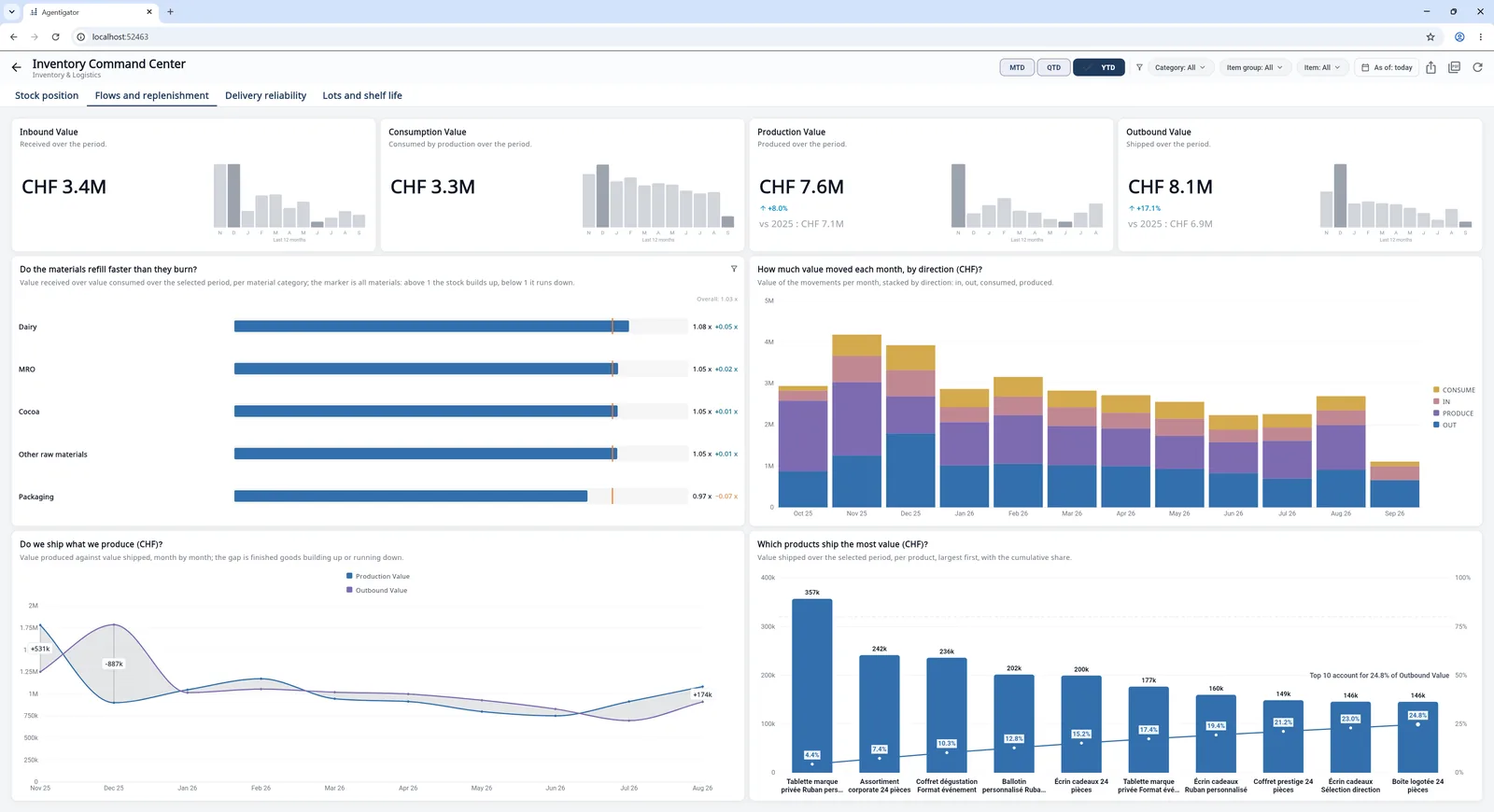
How much stock we hold and for how long, whether it refills faster than it burns, what is about to expire, and whether we ship on time.
How much stock is close to its expiry date, which items and lots carry it, and whether the intake is getting shorter-dated.
Which items are close to running out at the recent pace of usage, and which categories hold the least days of stock. Safety stocks and reorder points are not in the data, the coverage reads against the last 90 days of usage.
What comes in and what goes out, in value and in moves, and how the two sides compare by category and by month.
How fast we ship after the order, how often we are late and by how much, and which customers and products wait the longest.
How fast the stock turns, which months ship the most, and how the stock is built up ahead of the season.
How much raw material we hold and for how long, what production consumes, and which materials are close to running out.
How much finished product we hold and for how long, whether we ship what we produce, and which products sit on the shelf.
Every lot received: what it is, where it came from, how much of it is still on hand and when it expires.
How many days of stock we hold at the recent pace of usage, where it is short and where it is excessive, and whether the stock refills faster than it burns.
How much the warehouse handles, in moves and units, when the peaks fall, and how fast orders leave the dock.
Every movement on record: what moved, in which direction, for which items and partners, and how it changed the stock.
How much we buy and from whom, what we pay against the standard, whether the suppliers deliver on time, and what is still on the road.
Where the money goes by category and item, how the spend changed and why, and how each category is sourced.
Who we buy from and how much we depend on each, whether they deliver on time and how fast, and where the exposure sits.
What we pay per unit and how it moves, what we pay against the standard, and where the same item costs more from one supplier than from another.
What is ordered and still on the road, when it is due and how long it has waited, what is expected to land, and what is still a quotation.
How the ordering runs: how many orders and lines, how small they are, how fast the receipts land, and which months and weekdays carry the workload.